English
Reading Curriculum Intent
At The Drive Primary School, we believe that reading is the key that unlocks all learning and empowers children to become confident, successful and lifelong learners. We are committed to developing a love of reading through a rich and engaging curriculum that enables every child to become a fluent, enthusiastic and thoughtful reader.
Reading sits at the heart of our curriculum because it provides pupils with the knowledge, vocabulary and cultural capital they need to thrive both in school and beyond. Through exposure to high-quality texts, children develop their imagination, creativity, empathy and understanding of the world around them. Reading enables pupils to access all areas of learning and supports their personal, social and academic development.
Our reading curriculum is carefully designed to ensure that all pupils:
- Develop secure phonic knowledge and decoding skills, enabling them to read accurately and fluently.
- Build a broad vocabulary and understanding of language.
- Read with increasing confidence, expression and stamina.
- Understand, interpret and discuss a wide range of texts from different genres, authors and cultures.
- Use reading strategies to retrieve information, make inferences, predict, summarise and evaluate texts.
- Develop critical thinking skills and justify their opinions using evidence from what they have read.
- Foster a genuine enjoyment of reading and choose to read for pleasure both in and out of school.
Through high-quality teaching, enriching reading experiences and carefully selected texts, pupils gain the knowledge and skills needed to become independent readers who can access the wider curriculum and succeed in their future education.
Our reading curriculum supports The Drive Primary School’s vision by nurturing pupils who are curious, resilient and confident learners. By encouraging children to explore new ideas, understand different perspectives and challenge their thinking, reading helps them become respectful, informed and responsible citizens. We strive to ensure that every child leaves The Drive as a fluent reader with a lifelong love of books and the confidence to achieve their full potential.
At The Drive Primary School, we believe that every child can become a reader, and through reading, every child can succeed.
Reading Curriculum Implementation
At The Drive Primary School, reading is taught through a carefully planned and progressive curriculum that ensures all pupils develop the knowledge and skills needed to become fluent, confident and enthusiastic readers. Our approach is built around a three-tiered model of learning to read: Phonics, Fluency and Comprehension, with each element carefully sequenced to support pupils' reading development from the Early Years through to Year 6.
Phonics
At The Drive Primary School, we recognise that phonics is the foundation of reading and writing. We use Sounds-Write, a Department for Education validated systematic phonics programme, to teach children how the sounds of spoken language are represented by letters and letter combinations in written words. Sounds-Write is a highly structured, cumulative and evidence-informed programme that teaches children to become confident readers and spellers through a clear understanding of the alphabetic code.
Our phonics teaching begins as soon as children enter Reception and is delivered through daily, high-quality lessons. Sounds-Write takes a sound-to-print approach, helping children understand that words are made up of sounds (phonemes) and that these sounds can be represented in different ways through spelling patterns (graphemes). This approach develops secure foundations for both reading and spelling and avoids children relying on guessing strategies.
Through Sounds-Write, pupils are explicitly taught the three core skills that underpin reading and spelling:
- Blending sounds together to read words.
- Segmenting words into individual sounds for spelling.
- Phoneme manipulation, helping children develop flexibility and accuracy when working with sounds in words.
The programme is carefully sequenced so that children build their knowledge gradually, moving from simple sound-spelling correspondences to more complex patterns within the English language. New learning is regularly revisited through retrieval practice, enabling pupils to develop automaticity and long-term retention. Lessons are multisensory, engaging and inclusive, ensuring that all children can participate and succeed.
Assessment is an integral part of our phonics provision. Regular monitoring allows teachers to identify children who require additional support and provide timely intervention so that all pupils keep pace with the programme. Our aim is for every child to develop secure decoding skills, enabling them to read unfamiliar words accurately and confidently.
Further information about our phonics programme can be found on the Sounds-Write website:
🔗 Sounds-Write for Parents:
https://sounds-write.co.uk/parents/
Reading at Home
Reading regularly at home is an important part of every child's journey to becoming a successful reader. To support this, children are provided with a weekly decodable home reading book that is carefully matched to Sounds-Write and is typically linked to learning from approximately two units prior to their current teaching in class. This approach ensures that pupils are reading books containing phonics knowledge and spelling patterns they have already been explicitly taught and securely practised, enabling them to experience success and develop confidence as readers.
Alongside their decodable reading book, children are also encouraged to develop a love of reading through choice and enjoyment. Pupils regularly select a reading for pleasure book to take home and share with their family.
We value the partnership between home and school and encourage parents and carers to read regularly with their child, celebrate achievements and share in the enjoyment that reading brings. Through the combination of decodable reading practice and reading for pleasure, we aim to develop both skilled readers and enthusiastic readers at The Drive Primary School.
Fluency
Once pupils have secured their phonics knowledge, typically by the end of Key Stage 1, the focus shifts to developing reading fluency. Fluency is important because it enables children to read accurately, automatically and with expression, allowing them to concentrate on understanding what they read rather than decoding individual words.
At The Drive Primary School, fluency is taught throughout Lower Key Stage 2 through a combination of whole-class teaching and targeted interventions. Pupils' fluency is regularly assessed to identify those who would benefit from additional support and to ensure all children continue to make progress.
A key part of our approach is the use of Reader's Theatre, where pupils rehearse and perform texts through repeated reading. Alongside modelled, echo and choral reading, this helps children develop accuracy, automaticity, expression, confidence and deeper understanding of texts.
Through this structured approach, pupils successfully move from learning to read to reading to learn, becoming confident and fluent readers who can access the wider curriculum successfully.
Comprehension
The final stage of our three-tiered approach to reading is Comprehension. Once pupils become fluent readers, they focus on understanding, analysing and evaluating a range of increasingly challenging texts.
In Upper Key Stage 2, comprehension is taught through the VIPERS framework:
- Vocabulary
- Inference
- Prediction
- Explanation
- Retrieval
- Summarising/Sequencing
Through whole-class reading lessons, pupils develop these skills by discussing texts, justifying their ideas with evidence and exploring authors' choices. Children are exposed to a wide range of fiction, non-fiction and poetry, helping to broaden their vocabulary, knowledge and cultural capital.
To further develop comprehension, vocabulary and reading stamina, pupils use Reading Plus, an adaptive online programme that provides personalised reading pathways and supports pupils in becoming increasingly independent readers.
How to log in:
Step 1: https://student.readingplus.com/seereader/api/sec/login
Step 2: Press the Student Login button
Step 3: Enter Site Code: rpthedr1
Step 4: Enter your username
Step 5: Enter your password
Promoting a Love of Reading
At The Drive Primary School, reading is at the heart of school life. From the moment you enter the building, you will see books everywhere, in corridors, classrooms, the hall and dedicated reading spaces, creating a rich environment that celebrates reading at every opportunity.
Every classroom contains a carefully chosen selection of fiction, non-fiction and poetry books, alongside topic-related texts that support learning across the curriculum. Our well-stocked library gives children access to a wide range of authors, genres and text types, helping them discover new interests and develop positive reading habits.
We are proud to have worked alongside World of Stories to enrich our library stock. Children can also enjoy stories through our Yoto Player and explore our popular comic and graphic novel area, ensuring there is something to inspire every reader.
By surrounding children with books and providing regular opportunities to read, listen to and talk about stories, we aim to develop enthusiastic, lifelong readers who read for both learning and pleasure.
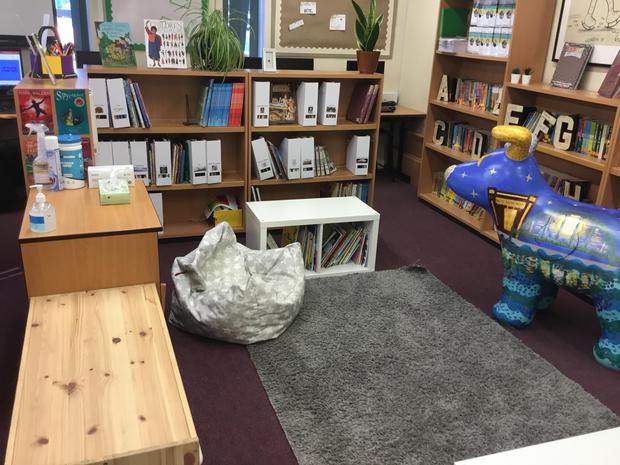
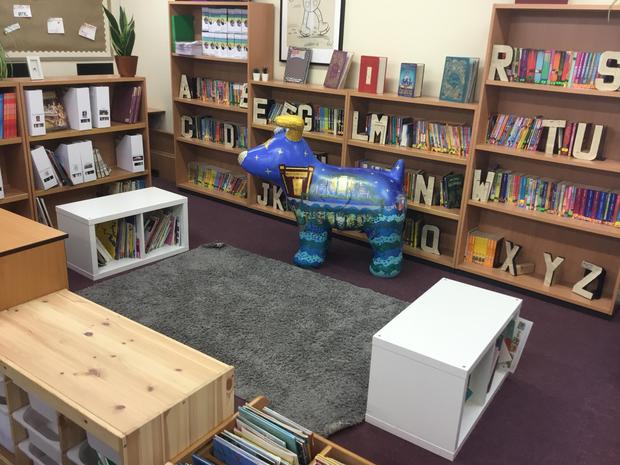
See a book you like? Please take one!
In school, we have a 'Reading for Pleasure Bookcase', where children can choose a book whenever they like, take it home and keep it! This will help them build their own mini-home library and encourage them to read more for pleasure.
We also host Free Book Fridays. This is an opportunity for our children to choose from a wide selection of books, take them home and keep them.
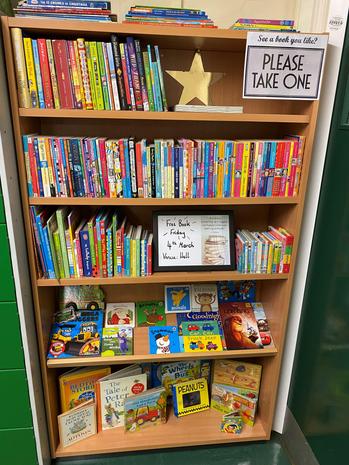
Our children have shown a real enthusiasm for reading recently and are choosing books to read at home, which must continue to be encouraged. With this in mind, can we all remind parents and carers of our, 'see one take one', book selection that the children can pick from, keep or just borrow (separate from the library) if they wish! Let’s get reading everyone!
Supporting All Learners
At The Drive Primary School, we believe every child can become a successful reader. Through adaptive teaching, carefully planned scaffolds and targeted support, we ensure that all pupils, including those with SEND, can access and succeed in reading.
Our three-tiered approach of Phonics, Fluency and Comprehension enables us to identify barriers early and provide appropriate interventions tailored to individual needs. Support may include adapted resources, pre-teaching of vocabulary, small-group interventions, assistive technology and additional adult support.
We work closely with families and external professionals to ensure pupils receive the support they need to make progress and develop confidence as readers.
Teaching of Writing
At The Drive Community Primary School, we believe that writing is one of the primary forms of communication and to write with confidence and accuracy is an essential life skill. Writing is a complex process that draws upon more than handwriting and spelling. It is the ability to effectively communicate ideas, express emotions, state opinions, explain understanding and share experiences and stories. It is also one of the more difficult aspects of the language as its many conventions are difficult to follow and master.
However, given the right environment and stimulus it is an aspect of literacy that can give enormous pleasure. We aim to set high expectations and enable our pupils to consider themselves as ‘writers’. We always encourage confidence, independence and the motivation to want to write and to have sufficient control over the mechanics of their writing to allow for skillful development of the writing process.
Aims and objectives:
Our aims are for all children at The Drive Community Primary School to:
- Write with confidence, clarity and imagination
- Understand and apply their knowledge of phonics and spelling
- Understand how to write in a range of genres (including fiction, non-fiction and poetry), using the appropriate style, structure and features
- Experience of a variety of reading materials and writing styles to appreciate and understand the purpose and audience of writing.
- Develop their vocabulary including technical and expressive language
- Understand the importance of planning, drafting and editing
- Use a wide range of resources to support and enable them to become independent writers: toolkits, WAGOLL, ‘boxing up’ plans, dictionaries, thesauruses, word banks, word mats, picture/story maps, wall displays.
Action and Implementation
We follow the National Curriculum (2014) which ensures that a range of genres are covered, including fiction, non-fiction and poetry.
Genres are taught and learnt considering the:
- purpose
- form
- audience
Throughout each unit of work, we use the following process to teach the process of writing. Within this structure there may be some flexibility to meet the needs of the pupils or the unit of work (EYFS use a modified version to serve Development Matters framework).
Explore
Plan
Innovate
Teach
Write
Improve/Edit
Explore with a WAGOLL
With every unit of work, it is important that children are familiar with the genre of writing. In this Explore stage, the class book may explicitly link, or they are shown a range of texts from the focused genre, so they are aware of the structure, layout and language used. At this stage children will be presented with a ‘What a Good One Looks Like’ (WAGOLL) which allows children to see the expected standard of work they should be working towards achieving.
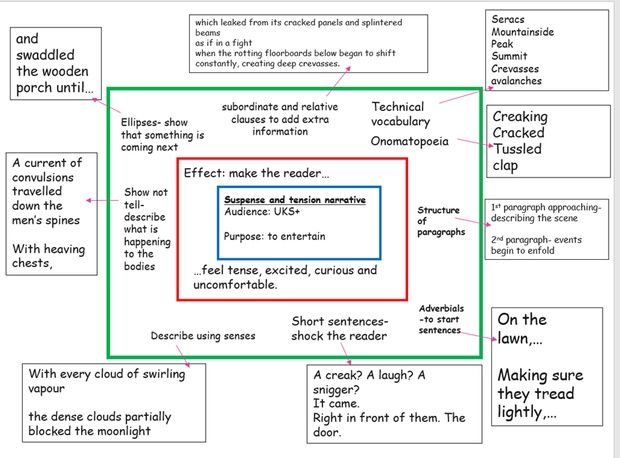
Plan with a Toolkit
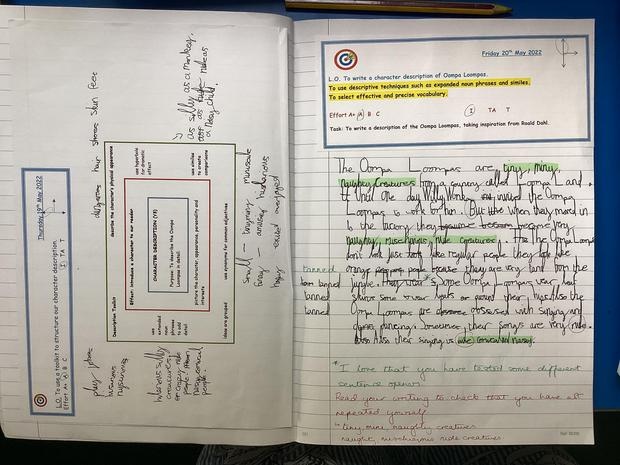
Once the children have explored examples of the focused genre, they will begin to plan their writing creating a toolkit (see below). At The Drive, we use toolkits (the layout originally promoted by James Durran and promoted by education Gateshead) so children are aware of the purpose and audience, the effect and the writing features they will be using. When possible, children should make their own toolkit alongside the teacher. English class displays include a toolkit which is amended with every new piece of writing allowing the children to interact and access the criteria independently and easily.
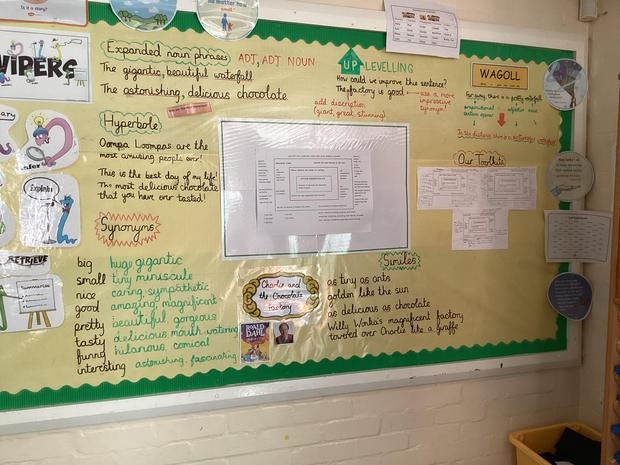
Innovate with Story maps or Boxing Up
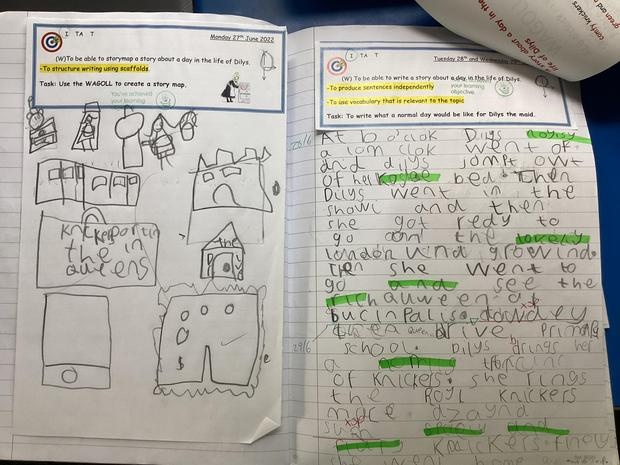
As children are more familiar with the chosen writing genre and WAGOLL, they can begin to innovate. A new subject is presented (different from that in the WAGOLL) and the teacher leads children to take ideas and examples from the WAGOLL and retell a new version. A story map is used or the boxing up method (both taken from Pie Corbitt’s Talk for Writing approach).
Learning Objectives
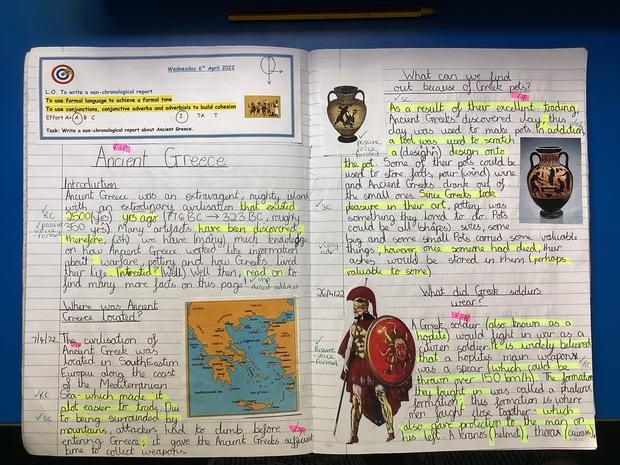
For each piece of writing a learning objective is used which details the specific writing genre, the writing skills that children should use and the context of the writing piece.
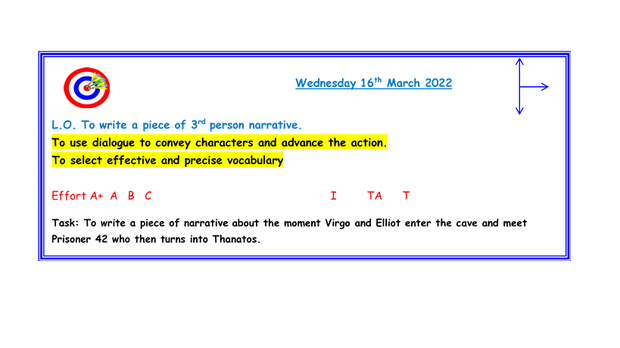
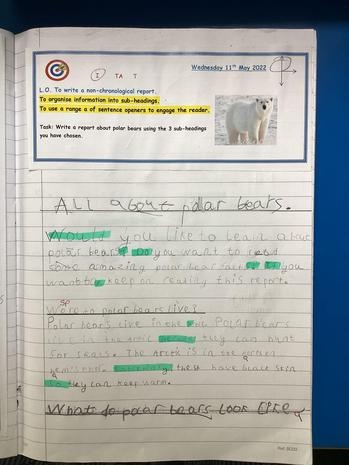
Examples of writing
National Curriculum Link
-
English Programmes of study: key stages 1 and 2
English National Curriculum